
Complaints Involving the Elbow and Arm
Where does the problem begin?
The elbow is a complex joint connecting the arm and forearm bones, where tendons, ligaments, and nerves work in unison. A problem in this area can lead not only to elbow pain but also to numbness in the hand, reduced grip strength, or restricted arm movement.
To determine the correct treatment, one must evaluate the location of the complaint, the movements that aggravate it, sports and work habits, and the impact on nerves in the hand and fingers.
Pain · Hand Numbness · Weakness · Loss of Movement · Swelling · Sports Injury
ELBOW AND ARM DISORDERS
Common Illnesses and Injuries
Tennis Elbow
Why does the outer side of your elbow hurt even though you don't play tennis?
-
Repetitive use of the tendons that move the wrist and fingers can cause pain, tenderness, and a loss of grip strength on the outer side of the elbow.
Cubital Tunnel Syndrome
Could the numbness in your little finger and ring finger be originating from your elbow?
-
Compression of the ulnar nerve, which passes along the inner side of the elbow, can lead to numbness and tingling in the little and ring fingers and, in advanced cases, a loss of strength in the hand.
Elbow Osteoarthritis
How do you fully extend your elbow?
-
Damage to the cartilage on the joint surface over time or following injuries can lead to pain, stiffness, and limited mobility.
TRAUMA AND OTHER ELBOW AND ARM PROBLEMS
From Strain to Complex Injuries.
Elbow and arm problems can arise from falls, impacts, sports injuries, sudden strains, or repetitive movements. Damage to bones, joints, tendons, ligaments, and nerves can affect arm movement, strength, and hand function.
01
Fractures and Dislocations Around the Elbow
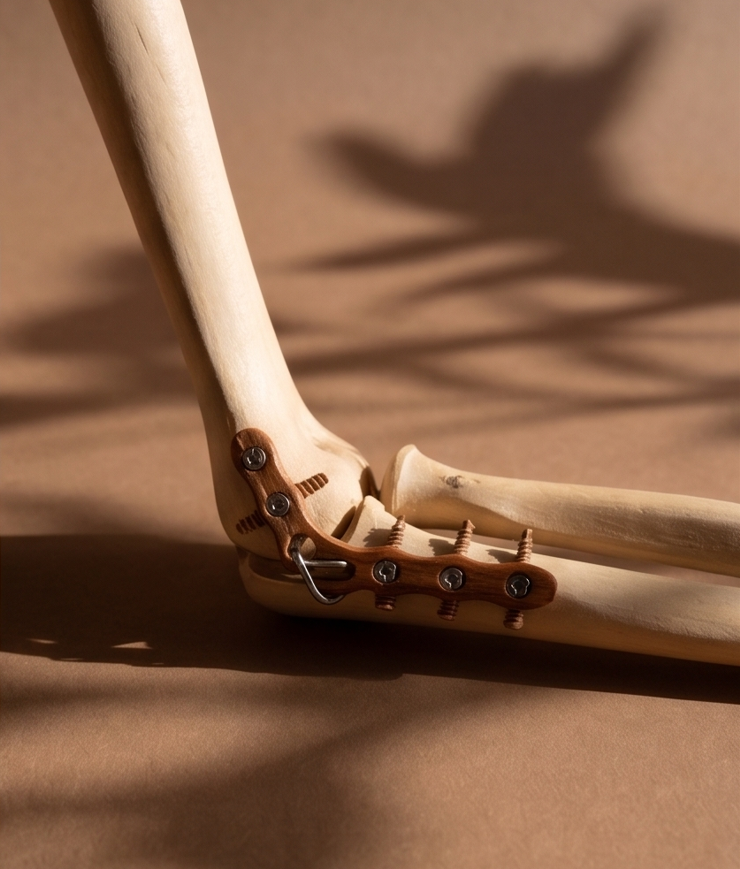
A fracture of the bones forming the elbow or a dislocation of the joint may occur following a fall or a direct blow. Treatment is planned based on the nature of the injury and its impact on the joint surface.
02
Biceps and Triceps Tendon Injuries
Partial or complete tears may occur in the tendons responsible for elbow flexion and extension as a result of sudden strain or trauma. Loss of strength and deformity may be observed.
03
Elbow Ligament Injuries
The ligaments that stabilize the elbow can be damaged following sports activities, a fall, or a dislocation. This condition can lead to a sense of instability during movement, pain, and joint instability.
04
Elbow Stiffness and Loss of Motion
Trauma, surgery, prolonged immobility, or intra-articular problems can prevent the elbow from fully extending and flexing, and restrict daily movements.
05
Nerve Injuries and Paralysis
Injury to the nerves running along the arm can lead to loss of sensation, weakness, or the inability to perform certain movements in the hand and fingers.
06
Sports and Overuse Injuries
Repetitive throwing, lifting, gripping, and work-related movements can lead to pain, tenderness, and a loss of performance in the muscles and tendons around the elbow.
Surgery: For the Right Patient, at the Right Time.
Not every problem involving the hand, wrist, elbow, or shoulder requires surgery.
Treatment is planned by collectively evaluating the source of the problem, the patient’s age, occupation, activity level, and expectations, as well as the characteristics of the condition.
In cases where non-surgical methods are insufficient or the injury requires immediate surgery, the appropriate method for the patient and the specific problem is determined.